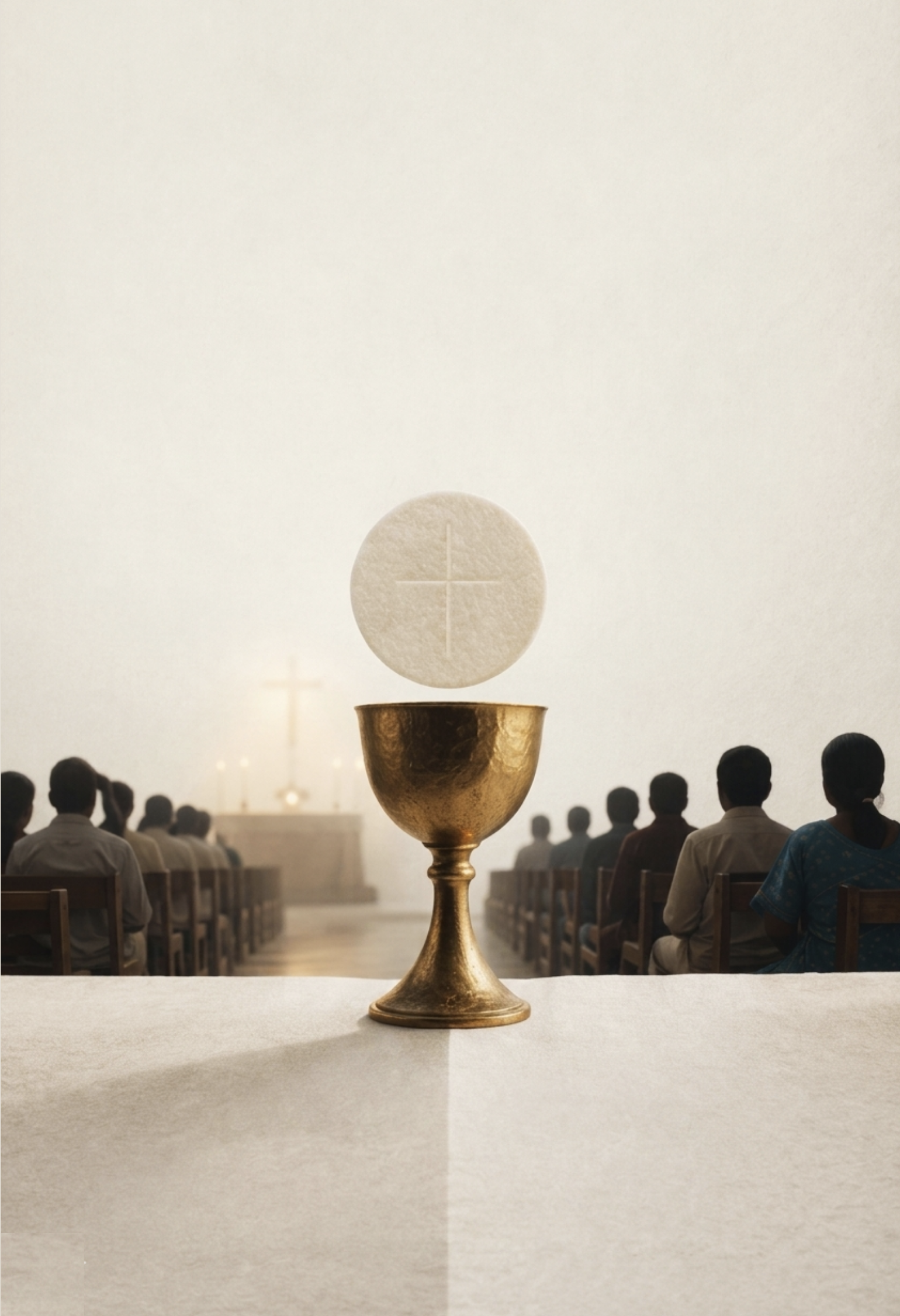
Feel free to copy, print and disseminate this story anywhere you like.
For every Dalit Christian — man, woman, girl and boy.
‘There is neither Jew nor Greek, slave nor free, male nor female — for you are all one in Christ Jesus.’
Galatians 3:28
‘When he had finished washing their feet, he put on his clothes and returned to his place. “Do you understand what I have done for you?” he asked them.’
John 13:12
‘I opposed him to his face, because he stood condemned.’
Galatians 2:11
A Note Before You Read
This is a work of fiction. Peter and Paul do not visit Indian parishes. The characters of Father Anand, Joseph, Mr Pillai, Susanna, Thomas, Rajan and Maria are invented. This Parish of Saint Thomas the Apostle does not exist.
Everything else in this book is true.
It was written in solidarity with the work of the National Dalit Christian Watch.
Chapter 1
The Arrival
The flight from Rome was long, and Peter slept badly.
He had slept badly on boats too, in the old days — not from fear but from the particular restlessness of a man who thinks better when his hands are occupied. On the water there had always been nets to check, ropes to coil, something to do with the night hours. On the plane there was nothing but a small screen showing a map with a moving arrow, and somewhere below, the darkness of the world.
He had been sent, as he had always been sent. That had not changed.
The city received him the way cities receive everyone — with noise and heat and the press of people who have somewhere else to be. Father Anand was waiting at the arrivals gate, a small, neat man in his fifties with a bright smile and a handwritten sign that said SIMON PETER in large, careful letters. Peter found this touching. He had not seen his name written like that — his full name, both names — in a long time.
‘Welcome, welcome,’ Father Anand said, taking his bag before Peter could object. ‘You must be exhausted. We will go straight to the parish. The community is very excited.’
‘That’s kind of them,’ Peter said.
‘We have prepared a meal. Nothing elaborate. Just the family.’
Peter looked out of the car window at the city passing — the temples, the hoardings, the women carrying improbable weights on their heads with a straightness of spine that made him think of the women who had carried water in Galilee. He felt the familiar sensation of arriving somewhere new that was also, in some way he could not quite articulate, somewhere very old.
‘Tell me about the parish,’ he said.
Father Anand told him. It was a large parish by local standards — three Sunday Masses, a school, a small clinic run by the Sisters. A good community, he said. Faithful. Generous. They had recently repainted the church and installed a new sound system. Attendance was strong.
‘And the people get along?’ Peter asked.
Father Anand glanced at him in the mirror. ‘Of course. We are one family in Christ.’
‘Good,’ Peter said.
He watched the city give way to smaller roads, greener and quieter, and did not ask any more questions. There would be time. There was always time, if you were patient and you watched.
— — —
The parish of Saint Thomas the Apostle — the choice of patron had always seemed to Peter both apt and slightly pointed, given everything — was a handsome whitewashed building set back from the road behind a low wall. A group of parishioners had gathered outside to welcome him, the women in bright saris, the men in their Sunday clothes though it was a Thursday. Children had been arranged at the front. Someone had made a garland of marigolds.
Peter accepted the garland with the grace he had learned over many years of being received in places that expected him to be more than he was. He shook hands, smiled, allowed himself to be photographed. A young woman offered him coconut water in a brass cup, and he drank it gratefully because he was genuinely thirsty.
He noticed, as he was guided inside, that the people who had garlanded him and offered him coconut water were not the same people who now stood at a slight distance, watching. These were quieter. Less arranged. Their clothes were clean but plainer. A man of perhaps sixty stood with his hands folded and his eyes lowered, and when Peter caught his eye the man smiled — a careful, watchful smile, the smile of someone who has learned to be careful about what he shows.
Peter smiled back.
Father Anand was already steering him towards the presbytery, talking about the programme for the visit, the meetings that had been arranged, the school Mass on Friday morning. Peter went with him, because that was what was expected, and because he had learned long ago that the things you notice on the first day are not always the things you should act on immediately.
But he had noticed.
— — —
That evening there was a meal in the parish hall. It was, as Father Anand had promised, nothing elaborate — rice and dal and vegetable curry and something sweet to finish that Peter could not identify but liked very much. Perhaps thirty people sat at long tables, and there was laughter and noise and the particular warmth of a community that is genuinely pleased to have a visitor.
Peter sat at the top table with Father Anand and three other men who were introduced as parish councillors — businessmen, he gathered, prosperous and generous and clearly accustomed to sitting at the top table. They were attentive hosts. They made sure his plate was full.
He looked around the room.
The man with the careful smile was not there.
Nor were the quieter people who had stood at the edge of the welcome. He counted the faces and found perhaps a dozen he did not recognise from outside. All of them, he realised, were at a separate table near the door — not excluded exactly, not turned away, but gathered at a distance from the main tables as though by some gravitational force that everyone understood and no one had needed to explain.
‘Who are those people?’ he asked Father Anand quietly, nodding towards the table by the door.
Father Anand glanced over. ‘Oh — those are our Dalit brothers and sisters. Very faithful people. They always come to help with the clearing up afterwards.’
‘I see,’ Peter said.
He looked at the table near the door. He looked at his own plate. He felt something move in him — not anger, not yet. Something older than anger. Recognition.
He had been at this table before. Not this table, but one like it. In Antioch. A long table with the right people at the centre and the others at the edges, and himself in the position of honour, eating comfortably while the arrangement did its quiet work around him. He remembered the exact moment he had made his choice in that room — the visitors from Jerusalem arriving, the social calculus, the getting up, the moving. How easy it had been. How natural. How Paul’s face had looked afterwards.
He picked up his plate and his glass.
‘I think I will go and sit with them for a while,’ he said. ‘If you will excuse me.’
It was not a grand gesture. He did not want it to be. But he noticed, as he stood, that his hands were not entirely steady — because the last time he had been in a room like this, he had moved in the other direction. And the body remembers these things even when the mind has repented of them.
The table near the door went quiet as he approached. The man with the careful smile looked up, and this time the smile was different — surprised, uncertain, as though kindness were a thing to be examined for hidden costs before accepting.
Peter sat down.
‘My name is Simon,’ he said. ‘Tell me about yourselves.’
| 1 |
Chapter 2
The Man with the Careful Smile
His name was Joseph.
He was sixty-three years old, he said, though he looked older — the kind of older that comes not from years but from the particular weight of a life spent being careful. He had worked for forty years in the tile factory on the edge of town, retiring when his knees gave out. He had six children, all baptised, all confirmed, three of them married in the church. He had never missed a Sunday Mass in his adult life except for the week his wife died.
‘You loved her very much,’ Peter said.
‘Very much,’ Joseph said. He said it simply, without performance, the way people speak about things that are simply true.
They were sitting outside Joseph’s house the following morning — a small, clean house on a lane at the edge of the parish boundary. Joseph’s daughter had brought tea without being asked, and Peter held the glass in both hands the way Joseph held his, because it was hot and it was good and it deserved to be held properly.
‘Tell me about the parish,’ Peter said. ‘What is it like to belong here?’
Joseph was quiet for a moment. Not evasive — considering. He was, Peter had already understood, a man who chose his words because he had learned that words have consequences.
‘It is our parish,’ Joseph said finally. ‘We were baptised here. Our children were baptised here. My wife is buried here.’ He paused. ‘In the section at the back, near the wall.’
‘Is that where you will be buried?’
‘Yes.’
‘And Father Anand? Where will he be buried?’
Joseph looked at him steadily. ‘In the main section. Near the centre. Near the other fathers.’
‘And the parish councillors? Mr Pillai and the others?’
‘Also the main section.’
Peter drank his tea. A small child appeared in the doorway of the house and stared at him with the frank curiosity of the very young. Peter stared back until the child laughed and disappeared.
‘Tell me about Sunday Mass,’ Peter said.
— — —
Joseph told him.
They sat at the back, he said. Not because they were told to — not any more, not in so many words. But the front pews filled early with the same families every week, and if a Dalit family sat there, the welcome was of a particular kind. A coolness. A slight rearrangement. A sense of having misunderstood something that everyone else understood without being told.
So they sat at the back.
At communion they went last. Again — not a rule. Just a pattern so old that it had become invisible, like the colour of the walls or the shape of the door. The ministers of communion worked their way from the front, and by the time they reached the back the queue had a different quality to it. Nobody said anything. Nobody needed to.
‘And afterwards?’ Peter asked. ‘The parish events? The festivals?’
Joseph smiled the careful smile. ‘We help with the setting up,’ he said. ‘And the clearing away.’
‘But not the sitting down in between.’
‘Sometimes,’ Joseph said. ‘At the table near the door.’
Peter set down his glass. He looked at the lane, at the small houses, at the child who had reappeared in the doorway and was now watching him with deep suspicion.
‘Joseph,’ he said. ‘When you receive communion — when the minister places the host in your hands and says “The Body of Christ” — what do you feel?’
Joseph took a long time to answer.
‘I feel that it is true,’ he said at last. ‘Whatever else — I feel that it is true. That he is there. That he does not —’ He stopped.
‘That he does not what?’
‘That he does not see what they see when they look at me,’ Joseph said quietly. ‘That at that moment, at least, I am only his.’
Peter looked at the ground for a moment.
‘You are always only his,’ he said. ‘That is what I need you to understand. And what I need some others to understand also.’
He said it with conviction. He meant it. But walking back to the presbytery afterwards, he thought about the distance between meaning something and acting on it — a distance he knew better than most, because he had crossed it in one direction at Caesarea and in the other at Antioch, and the crossing in both directions had cost him something he had not expected to pay.
— — —
Later that morning Peter walked to the church.
It was empty at that hour, cool and dim after the brightness outside, the smell of candles and old incense and something floral from the arrangement near the statue of Our Lady. He walked slowly up the centre aisle, looking at the pews.
Near the front the kneelers were padded. He crouched and pressed one with his hand — firm, well-maintained, recently recovered in a dark red fabric.
He walked to the back. The kneelers there were wooden. Not broken — just wood. The difference was not dramatic. It did not need to be.
He looked at the altar.
One altar. One table. The same words said over the same bread and the same wine. The same Christ, offered and received. He stood for a long time looking at it, thinking about a night in Jerusalem a very long time ago, a borrowed room, a table that had not been arranged by rank.
He thought about what he had done at Antioch.
He thought about Paul’s face.
He went to find Father Anand.
| 2 |
Chapter 3
What Happened at Antioch
Father Anand received him in the presbytery with fresh coffee and evident pleasure. He was a good man, Peter had decided — genuinely good, in the way that makes certain kinds of wrongdoing possible. The wrongdoing that does not know itself. The sin that has been administered so long it has become a sacrament of its own.
‘I spent the morning with Joseph,’ Peter said.
‘Ah — Joseph. A wonderful man. So faithful. They are all so faithful, the Dalit community. Truly, they put the rest of us to shame sometimes.’
‘He told me about the seating.’
Father Anand made a small gesture — not dismissive exactly, but practised. ‘These are cultural patterns,’ he said. ‘Very old. We are working on them gradually. Change takes time, as I am sure you know. We cannot force these things.’
‘Can we not?’ Peter said mildly.
Father Anand set down his cup. He looked at Peter with the expression of a man who has heard this conversation coming and has prepared his answers.
‘I will be honest with you,’ he said. ‘Because I think you are a man who appreciates honesty. The upper-caste families are also our parishioners. They are generous — the school, the clinic, the new sound system, the roof we replaced last year. Much of what we have here comes from their support. That is not a justification. It is a fact. If I move too fast, I lose them. And if I lose them, I lose the school. I lose the clinic. I lose the things that serve the whole community — including the Dalit community.’
He leaned forward slightly.
‘I have been a priest for twenty-eight years,’ he said. ‘I have seen what happens when a priest moves too fast on these things. In the diocese south of here a young priest refused to conduct a separate funeral for a Dalit family — insisted on the main cemetery, in the main section. The upper-caste families left the parish. Forty per cent of the congregation, gone. The school closed within a year. The bishop transferred the priest. That is what happened to the last man who decided to force these things. So when you say “can we not,” I want you to understand that I am not choosing comfort over principle. I am choosing to keep a parish alive.’
Peter listened carefully. He said nothing for a moment.
‘I understand the argument,’ he said at last. ‘I understand it better than you might think. Because I have made that argument myself. Not in those words — but in that shape. The argument that says: the important thing is to keep the community together. The argument that says: we cannot risk the larger good for the sake of a confrontation. The argument that says: let the larger truth work itself out gradually.’
He paused.
‘I would like to talk to you about a meal I once attended. In Antioch. And about something a friend of mine said to me afterwards.’ He paused. ‘It was not a comfortable conversation. But it was a necessary one.’
Father Anand looked at him carefully.
‘I think,’ Peter said, ‘that we may be about to have a similar one.’
— — —
Father Anand poured more coffee, which gave him something to do with his hands.
Peter waited.
Outside, a crow was making an argument with itself on the presbytery wall. Somewhere in the school building adjacent, children were reciting something in unison — mathematics, perhaps, or a prayer. The sounds of a parish going about its ordinary business on an ordinary morning, unaware that anything was being decided.
‘Antioch,’ Father Anand said carefully. ‘You mentioned Antioch.’
‘I did.’
‘This is — a scripture reference?’
‘It is a memory,’ Peter said. ‘My own. Though Paul wrote it down afterwards, so perhaps it is both.’
He set down his cup.
‘We had a community there — a good community, not unlike this one in some ways. Jewish Christians and Gentile Christians worshipping together, eating together. It was not easy at first. The Jewish Christians had laws about food, about purity, about who you could sit with and whose hands could touch your plate. Very old laws. Deeply felt. Not malicious — simply the way things had always been done, sanctified by centuries of practice.’
Father Anand nodded slowly. He was listening with the careful attention of a man who suspects he knows where a story is going and is hoping to be wrong.
‘For a while,’ Peter continued, ‘I ate with the Gentile Christians freely. It felt right. It was right. We were one community — one bread, one cup, one Lord. And then some people arrived from Jerusalem. People who held strongly to the old distinctions. And I —’
He stopped.
‘What did you do?’ Father Anand asked, though his voice suggested he already knew.
‘I moved,’ Peter said simply. ‘I got up from the table where I had been sitting with the Gentile Christians and I went to sit with the visitors from Jerusalem. Quietly. Without making a scene. And others followed my example, because people follow example, Father Anand — that is the terrible power of it, especially when the example is set by someone in authority.’
The crow outside had stopped its argument. The children were still reciting.
‘I want you to understand something,’ Peter said. ‘I did not move because I had changed my mind. I still believed what I had always believed — that in Christ there is no distinction. I moved because the social cost of staying had become very high, very suddenly. And I told myself exactly what you told me five minutes ago. I told myself I was keeping the community together. I told myself the larger truth would work itself out gradually. I told myself that this was a temporary accommodation.’
He looked at his hands.
‘And then Paul saw it happen. He came to me — not privately, as I might have preferred. Publicly. In front of the community. And he said that I was not acting in line with the truth of the Gospel. Those were his words. Not acting in line with the truth of the Gospel. He said that I was compelling the Gentile Christians, by my behaviour, to live as though the old distinctions still applied. As though the cross had changed nothing. As though the table of the Lord was still a table with a hierarchy around it.’
Father Anand said nothing.
‘I was angry,’ Peter said. ‘At first I was angry. I was the one who had first opened the door to the Gentiles — I had seen the vision at Joppa, I had baptised Cornelius and his household when nobody else would. Who was Paul to stand up in front of everyone and correct me?’ He almost smiled. ‘But he was right. That was the thing I could not escape. He was entirely, uncomfortably, publicly right.’
Father Anand turned his coffee cup in its saucer.
‘Our situation is different,’ he said. ‘Caste is not the same as the Jewish purity laws. It is more complex. More deeply embedded. The social structures here — you cannot simply —’
‘Father Anand,’ Peter said. ‘Can I ask you something? The young priest in the diocese to the south. The one who insisted on the main cemetery.’
‘Yes.’
‘Was he wrong?’
A long silence.
‘He was right,’ Father Anand said quietly.
‘And the bishop who transferred him?’
Father Anand closed his eyes. ‘The bishop was —’
‘Wrong,’ Peter said. Not harshly. As a fact. ‘The bishop was wrong. And the forty per cent who left — they were wrong. And the school closing was a tragedy. But the young priest was right. And the dead person was buried in the right place. And somewhere in that diocese there is a Dalit family who knows that at least one priest believed what the Gospel says.’
‘And the school is closed,’ Father Anand said.
‘Yes,’ Peter said. ‘The school is closed. That is what it cost. I will not pretend it did not cost anything.’ He leaned forward. ‘But I want to ask you — could Joseph’s daughter have served the parish councillors that tea this morning? Could Joseph’s plate have been passed to Mr Pillai?’
A long silence.
‘These things take time,’ Father Anand said, but his voice had lost some of its practised smoothness.
‘Yes,’ Peter said. ‘They do. And they also take a decision. The time does not pass productively on its own.’ He leaned forward slightly. ‘I want to ask you something directly, and I would like a direct answer. At this altar — that altar there in your church — what happens at the consecration?’
Father Anand looked up. ‘The bread and wine become —’
‘Become what?’
‘The Body and Blood of Christ.’
‘For whom?’
A pause.
‘For all,’ Father Anand said quietly.
‘For Joseph?’
‘Yes.’
‘For Joseph’s daughter?’
‘Yes.’
‘For the man who will not let Joseph’s daughter serve him tea?’
Father Anand closed his eyes briefly. ‘Yes,’ he said.
‘Then something is wrong,’ Peter said. ‘Not culturally complicated. Not gradually improvable. Wrong. The same Lord who will not distinguish between them at the altar is being asked to preside over a community that distinguishes between them everywhere else. That is not a cultural pattern, Father Anand. That is a contradiction at the heart of the Eucharist itself.’
‘And the school?’ Father Anand said. It was not a challenge now. It was the question of a man who can see what is right and is trying to calculate whether he can afford it.
‘I do not know about the school,’ Peter said. ‘I am not telling you it will be easy. I am not telling you it will be painless. I am telling you that the thing you are doing now — the thing I once did — is a lie told at the table of the Lord. And eventually you have to decide whether you would rather have the school or the truth.’
The priest said nothing for a long time. Outside, the children had stopped reciting and there was the sound of a bell, and then the sound of running feet, and then laughter — the particular shapeless joyful noise of children released into a break, unconcerned with the conversation happening twenty metres away in the presbytery.
‘What do you want me to do?’ Father Anand asked at last. His voice was different now. Not the smooth voice. Something underneath.
‘I want you to call a meeting of the parish council,’ Peter said. ‘All of them. Including Joseph. Including the Dalit community.’ He paused. ‘And I would like to be there.’
Father Anand looked at him steadily. ‘That will not be a comfortable meeting.’
‘No,’ Peter agreed. ‘But it will be a necessary one. In my experience those are often the same meeting.’
He stood up, signalling that the conversation for now was over.
‘One more thing,’ he said. ‘Sunday Mass. I will be sitting at the back.’
Father Anand looked startled. ‘But you should be —’
‘At the back,’ Peter said pleasantly. ‘With Joseph. And I would be grateful if you would join me.’
— — —
He walked back to the church in the afternoon heat.
It was still empty. He sat in the back pew — the wooden kneeler, the slightly restricted view of the altar — and he stayed there for a long time in the particular silence that old churches accumulate like dust, layer upon layer of prayer soaked into the walls.
He thought about Cornelius, the Roman centurion, standing in his own house in Caesarea while Peter told him that God shows no partiality. He had believed it when he said it. He had believed it when he baptised the whole household. He had believed it right up until the moment it became socially inconvenient, in a dining room in Antioch, with the visitors from Jerusalem watching.
That was the thing he could never quite forgive himself for. Not the sin of it — he had been forgiven for that, and forgiven thoroughly, the way that man forgave everything, with an extravagance that left no room for self-punishment. What he could not forgive was the ease of it. How little effort it had taken. How smoothly the old reflex had reasserted itself — the reflex that said: these people matter more than those people. The reflex that dressed itself in prudence and called itself keeping the peace.
He had felt it again last night, sitting at the top table. Not strongly — not the way he had felt it at Antioch. But it had been there. The old pull. The comfort of being where the comfortable people were. The faint, almost imperceptible reluctance before he had picked up his plate and moved.
He wanted to pretend that reluctance had not been there. But he had learned, at great cost, that pretending is how it starts.
He thought about Paul’s face.
He thought about Joseph’s face.
He thought about a face he had last seen in a garden, in the early morning, after everything — looking at him across the charcoal fire with a question that was also a restoration: Do you love me?
Yes, he had said. You know that I do.
Then feed my sheep.
He looked at the altar for a long time.
All of them, he thought. All of them are his sheep. Every last one.
He bowed his head and began to pray for Father Anand, who was a good man standing at the edge of a necessary and difficult decision and who might lose a school for making it. And for Joseph, who received the Body of Christ each Sunday with a faith that put most people to shame. And for the parish councillors, who had perhaps never been asked to look at what they were doing with clear eyes.
And then, because old habits die hard and because he was who he was, he prayed for Paul — wherever he was, whatever he was doing, probably writing something that would make someone uncomfortable.
Which was, Peter reflected, usually a sign that it needed to be written.
| 3 |
Chapter 4
The Meeting
Father Anand had arranged the chairs in a circle.
Peter noticed this and was glad of it. A circle is harder to have a hierarchy in than a row of chairs facing a table. It was a small thing but it was not nothing.
There were fourteen people in the room. Eight from the parish council — Mr Pillai and his colleagues, substantial men in their best clothes, carrying the particular confidence of people accustomed to being listened to. And six from the Dalit community — Joseph, his daughter Maria, two younger men whose names Peter had learned were Thomas and Rajan, and an elderly woman called Susanna who had brought her rosary and was working through it quietly while she waited for things to begin, as though she had decided that prayer was the most useful contribution she could make to whatever was about to happen.
Peter thought she was probably right.
Father Anand opened with a prayer. It was a good prayer — sincere, a little nervous, asking for the Holy Spirit in terms that suggested he genuinely meant it and was not entirely sure he wanted what he was asking for. Peter said Amen with feeling.
Then silence.
Mr Pillai spoke first, which surprised nobody.
‘We are honoured by your visit,’ he said, addressing Peter with the smooth warmth of a man who has chaired many meetings. ‘Our parish has always been a welcoming community. Whatever questions you may have, I want to assure you that we take our responsibilities to all our parishioners very seriously.’
‘Thank you,’ Peter said. ‘I would like to hear from Joseph.’
A small shift in the room. Not dramatic — just a recalibration, a slight adjustment of expectation. Mr Pillai sat back with an expression of careful courtesy.
Joseph looked at his hands. Then he looked up.
‘My father was baptised in this church,’ he said. ‘My grandfather also. We have been Catholics for three generations. My grandfather helped to build this church — he carried the stones. He is buried at the back, near the wall.’ He paused. ‘Last year my grandson was refused at a birthday party. The family — a parish family, people we receive communion with every Sunday — told my daughter that the children should not mix. That it was not personal. Just the way things are.’
Silence.
‘Thomas,’ Peter said. ‘What would you like to say?’
Thomas was perhaps thirty — a lean, direct young man who had been visibly restraining himself since the meeting began. He leaned forward now.
‘I will tell you what it is like,’ he said. ‘Every Sunday I come to this church. I sit at the back because if I sit at the front people move. Not all of them — but enough. I receive communion last. When there are parish events I am welcome to help carry chairs and wash dishes and I am not welcome to sit at the main table. My sister applied for a job at the parish school and was told the position was filled. The next week there was a new teacher. She was not from our community.’
He sat back.
‘We are told we are one family in Christ,’ he said. ‘I would like to know which family this is, because in my experience families eat together.’
Mr Pillai shifted in his seat.
‘These are longstanding cultural practices,’ he said. ‘We did not invent them. They are part of the social fabric of this country. The Church operates within a society, not outside it. We cannot simply pretend that two thousand years of social structure do not exist.’
He looked around the circle, gathering support. Two of the other councillors nodded.
‘I have personally employed people from the Dalit community in my business,’ he continued. ‘My family has donated to the school, to the clinic, to the building fund. I do not think anyone here can question our commitment to this parish or its people.’
‘Nobody is questioning your generosity,’ Peter said.
‘Then what is being questioned?’
‘Whether generosity is the same thing as equality,’ Peter said quietly.
The room shifted again.
Mr Pillai’s face tightened. ‘With respect,’ he said, ‘you are a visitor here. You have been in this parish for three days. We have lived here all our lives. These are complex matters that cannot be resolved by a conversation.’
‘You’re right,’ Peter said. ‘They cannot. And I am a visitor. And three days is not enough to understand the complexity of what has taken centuries to build.’ He paused. ‘But I want to ask you something. And I want you to hear it as a genuine question, not as an accusation from an outsider.’
Mr Pillai looked at him warily. ‘Ask.’
‘When you receive the Body of Christ on Sunday — when the host is placed in your hands — do you believe that the same Christ is placed in Joseph’s hands ten minutes later?’
A long pause.
‘Yes,’ Mr Pillai said.
‘The same Christ. Not a lesser Christ. Not a Christ who has accommodated himself to local custom.’
‘The same Christ,’ Mr Pillai said, more quietly.
‘Then I want to tell you something,’ Peter said. ‘Not as a rebuke. As a man who has made this precise mistake himself.’
— — —
He told them about Antioch. Briefly, without embellishment — the community, the table, the visitors from Jerusalem, the getting up and moving. Paul’s face. The words: not acting in line with the truth of the Gospel.
‘I have been thinking, since I arrived here, about why I did it,’ he said. ‘It was not that I had stopped believing what I believed. I still believed that in Christ there was no distinction. I had seen it. I had preached it. But in that room, with those visitors watching, the social cost of acting on what I believed suddenly felt very high. And I told myself that it was a small thing. A temporary accommodation. That the important thing was to keep the peace and let the larger truth work itself out gradually.’
He looked around the circle.
‘I have heard similar things said in this room this morning,’ he said. ‘Not by bad people. By people who have told themselves that the important thing is to keep the peace. That change takes time. That the larger truth will work itself out gradually.’
‘The problem,’ Peter said, ‘is that the larger truth does not work itself out gradually on its own. It requires someone to act on it. And the longer the acting is deferred the more normal the contradiction becomes — until the people sitting at the back with the wooden kneelers have been there so long that everyone has forgotten there was ever a question about it.’
— — —
Peter let the silence sit for a moment. Then he turned to Susanna, who had stopped her rosary and was watching him with bright, patient eyes.
‘Susanna,’ he said. ‘How long have you been coming to this church?’
‘Sixty-one years,’ she said.
‘And in sixty-one years — have things changed?’
She considered this with the seriousness it deserved.
‘The kneelers at the back are still wood,’ she said.
One of the younger parish councillors looked at the floor.
Mr Pillai did not look at the floor. He looked at Susanna. Then he looked at Joseph. Something was happening behind his eyes — not conversion, not yet, but the beginning of a discomfort that could not be managed by the usual arguments.
‘My father used to say,’ Mr Pillai said slowly, ‘that caste is not our tradition as Christians. That we inherited it and it is not ours.’ He paused. ‘He said it. He did not always act on it.’ Another pause. ‘Neither have I.’
The room waited. Peter waited. He had learned not to fill these silences. They were where the real work happened.
‘I am not ready to agree to everything you are proposing,’ Mr Pillai said. ‘I need to think. I need to talk to the other families. I will not pretend that this is simple or that I can change forty years of habit in an afternoon.’
‘I am not asking you to change forty years in an afternoon,’ Peter said. ‘I am asking for one thing. One Sunday. One small, concrete, visible act of what we say we believe.’
— — —
He told them what he had in mind.
The room was quiet when he finished.
Susanna had resumed her rosary. Thomas was looking at Peter with an expression that was not hope — not yet, not quite. The careful, watchful look of someone who has been disappointed before and has learned to wait and see.
Joseph was looking at his hands.
Mr Pillai was looking at the window, and whatever he was seeing there seemed to require his full attention. When he finally turned back his face still had the quality of a man who has not finished his calculations, who has not decided and knows he has not decided, who is holding two things in his mind at the same time and finding that they do not fit together and never have.
‘One Sunday,’ he said at last. Not a promise. A concession. The difference mattered, and Peter did not pretend it did not.
‘One Sunday,’ Peter said. ‘And then we will see.’
| 4 |
Chapter 5
Sunday
The Mass began as it always began.
The entrance procession, the sign of the cross, the greeting. Father Anand’s voice was steady, Peter noted — steadier than he might have expected from a man who had slept as little as Peter suspected he had.
The church was full. Word had spread, as word always does in parishes, through some alchemy of whisper and inference that never quite announces itself but leaves everyone knowing what they know. People had arrived earlier than usual. The front pews had filled as they always filled — and then, to the quiet bewilderment of those in the front pews, so had the back ones.
Peter sat in the back pew. On his left was Joseph. On his right was Mr Pillai, who had arrived early, as Peter had asked, and who had sat down next to Joseph with the careful deliberateness of a man doing something he had decided to do before he could change his mind. Their arms were almost touching.
Susanna was two seats along, rosary wound around her wrist, watching the altar with the serene attention of someone who has been watching this altar for sixty-one years and finds it no less extraordinary for that.
Thomas and Rajan were behind them. Maria was next to her father.
Two of the parish councillors had also come to the back. Two others had not. Peter had not commented on this. It was a beginning, not a completion.
Beginnings are untidy.
The Liturgy of the Word moved as it always moves — the reading from the Old Testament, the psalm, the letter, the Gospel. Father Anand’s homily was short and direct and did not avoid anything. Peter had suggested a scripture and Father Anand had chosen it himself, which was better. Galatians. There is neither Jew nor Greek, slave nor free. He preached it plainly, without flourish, as a man who is saying something he means and knows it will cost him something and has decided to say it anyway. Peter thought it was the best homily he had heard in a long time.
At the offertory, Joseph’s daughter Maria carried the bread and wine to the altar.
This had not happened before.
Several people in the front pews registered it — a slight stillness, a moment of noticing. Then the Mass continued because the Mass continues, which is one of its great mercies.
At communion Father Anand came down from the altar and went to the back pew first.
Peter received. Joseph received. Mr Pillai received, his eyes closed, his face doing something private and important. Susanna received with the matter-of-fact reverence of long practice. Thomas received and when he raised his eyes from his hands there was something in them that had not been there at the beginning of Mass.
One bread. One body. One cup.
Beginning from the back.
It was a small thing.
It was not a small thing.
— — —
Afterwards there was a meal in the parish hall. The tables had been rearranged. Not into a circle exactly — there were too many people for that — but into one long continuous arrangement, no top table, no table by the door. Father Anand had done it himself, early that morning, before anyone else arrived.
Peter sat between Joseph and Mr Pillai. Mr Pillai served Joseph rice from the communal dish before serving himself. It was a small gesture. Joseph received it with the careful smile, which was becoming, Peter noticed, slightly less careful.
The food was the same food as always. The hall was the same hall. The people were — almost — the same people. But the room felt different in a way that was difficult to name and was not difficult to name at all.
Thomas leaned across the table towards Peter.
‘Will this last?’ he asked quietly. ‘After you leave?’
It was the right question. The honest question. Peter respected him for asking it.
‘I don’t know,’ Peter said.
He did not say ‘I think something has shifted.’ He did not say ‘Things that have shifted can shift further.’ He had learned, at Antioch and afterwards, that optimism about these things is a luxury the people sitting at the back cannot afford. It was not his place to offer hope he could not guarantee.
‘I don’t know,’ he said again. ‘What I know is this: next Sunday I will not be here. The Sunday after that I will not be here. And the question of whether Mr Pillai sits at the back pew or returns to the front is a question that Mr Pillai will answer, and Father Anand will answer, and the parish will answer, every single week, without me.’
Thomas nodded. He had expected this answer, Peter thought. He had been expecting it his whole life.
‘We have been waiting a long time for ordinary,’ Thomas said.
‘I know,’ Peter said. ‘I’m sorry it took so long.’
He meant it as a personal statement. He was also aware that he meant it as something more than that — on behalf of something larger than himself, an institution that had preached the equality of souls for two thousand years and had spent a considerable portion of that time failing to live it.
Across the table, Susanna was eating her food with quiet contentment, rosary wound around her wrist. She caught Peter’s eye and smiled at him — not the careful smile, just a smile, the straightforward uncomplicated smile of someone who prayed for sixty-one years that something would change and is now having her lunch.
Peter smiled back.
But he noticed, at the far end of the table, that two of the upper-caste families had left early. He noticed that Mr Pillai’s wife was not present. He noticed that one of the parish councillors who had come to the back pew was already talking quietly to Father Anand with an expression that suggested the conversation was not about the quality of the food.
One parish. One small rearrangement of tables. One Sunday.
He knew better than anyone how fragile beginnings are. He knew how quickly people revert, how powerful the gravity of the way things have always been done. He had reverted himself, in a dining room in Antioch, and it had taken Paul’s public intervention to pull him back.
He did not know whether Father Anand would hold this line. He did not know whether Mr Pillai’s concession would survive the week. He did not know whether the families who had left early would return next Sunday, and if they returned, whether they would return to the front pew or to the back, and whether the difference between those two choices would be legible to anyone but Joseph.
He did not know. And he would not be here to find out.
That was the hard thing. Not the confrontation. Not the meeting. Not the difficult conversation in the presbytery. The hard thing was leaving. The hard thing was knowing that you could light a fire and walk away and have no idea whether anyone would tend it.
He looked at the altar through the open door of the hall.
All of them, he thought. All of them are his sheep.
But he could not stay in every parish. He could not sit in every back pew. He could not pick up every plate and move it to every table near every door.
That was the work of the people who stayed.
| 5 |
A Final Word
The Eucharist is not a symbol of unity. It is unity. One bread, one body, one cup, one Lord. When caste operates at the table of the Lord — when some receive last, when some carry chairs and do not sit down, when some are buried near the wall — the words said over the bread and wine are being contradicted by the bodies in the room.
That is not a cultural complication. That is a lie told in the presence of the truth.
Dalit Christians in India also face a specific legal injustice that is less well known outside India. Under the Indian constitution, Dalit Hindus, Sikhs and Buddhists are entitled to scheduled caste reservations — affirmative action protections designed to address centuries of discrimination. Dalit Christians are not. The act of converting to Christianity cost them those protections. They fell between two systems and remain there.
If you are a Catholic in India reading this: you know what is true. The question is only what you do with it. And whether you do it next Sunday or wait for a visitor to come and do it for you.
If you are reading this elsewhere: find the National Dalit Christian Watch. Learn about the campaign for scheduled caste reservation rights for Dalit Christians. Support that campaign. Write to your bishop. Tell people this is happening. And please, if you can, make a donation. NDCW are training a new generation of young leaders but money is hard to come by.
And if you are ever in a parish hall anywhere — in India or anywhere else — and you see a table near the door, go and sit there.
Nobody is coming from Rome to fix this. That is not how it works. It has never been how it works. Peter left Antioch. Paul moved on. The community had to decide for itself what it believed and whether it was willing to live it.
So does yours.
Written in solidarity with the National Dalit Christian Watch